Pages

Thursday, October 22, 2009

Far but awesome new Thai Immigration Office


The tomo (Thai term for immigration office) has moved to its new location at the Government Complex on Soi 7, Chaeng Wattana, Nonthaburi Province on September 28, 2009. It opens at 8:30 AM to 4:30 PM Mondays to Fridays and lunch break is 12:00-1:00 PM.
Many "farangs" (foreigners) have aired out their complaints about the distance and the travel cost involved in getting there from the capital, Bangkok where most expats and tourists stay. The worst thing is, there is no other mode of transportation except taxi as there are no buses that go there. From the main road, it is still a few kilometers away. So if you process your visa, re-entry or 90 days reporting there, you need to have your own ride or to hire a taxi to wait as there are just a few in there. I got there today (for over an hour with all the traffic jams) through KMUTT's pick-up for my re-entry permit. My negative feeling was replaced with excitement though when I saw the magnificent building with all its TIT's (This is Thailand) uniqueness.
I experienced sweating out before in the old immigration office in Bangkok located on Suan Phlu. It was sooooo crowded then that the transfer was really necessary.
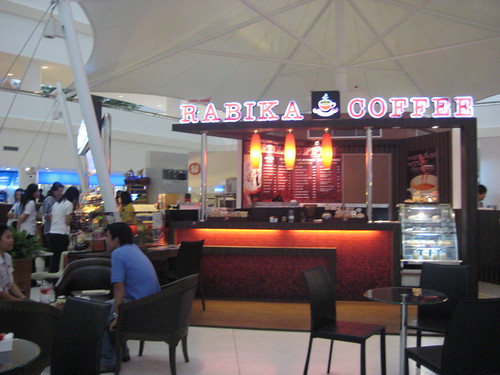
Even if I was in a hurry to get back to my office, I could not stop myself from wandering, wondering and taking photos around. The place is really awesome. It's more than just a government complex. It's also a shopping mall and a great place to hang out. It has everything you need - clothes, food, coffee shops, souvenirs even organic products and fruits and all kinds of banks with extraordinary services. So while waiting for your queue, you can go to the basement to have a cup of coffee or cappuccino, to shop some goodies for yourself or even to pay your bills at any of the bank of your choice or at 7-11 counter.


Friday, October 16, 2009

Beach or Pool?


This is such a very beautiful sight to behold from a high-rise hotel! Sooooo relaxing, isn't it? But can you notice the oil spills lining this beach? It's mainly caused by banana boats, the tractors that carry them to the beach and some jet-skis. Who should be blamed for this place's destruction?

This photo was taken by my then 10 year-old daughter, JD, from our room on the 19th Floor of Nusa Playa Hotel, a 5-star hotel in Jomtien, Pattaya during our department retreat in summer 2008 . Because of the oil spill, we didn't allow our kids to go swimming here as advised by our Thai friends.Tsk!Tsk! So they just enjoyed swimming at the hotel's pool on the 5th Floor (shown on photo below taken by Josh).
It's choosing between nature and man-made. But what better choice is left? Mom and dad know better so sorry to our kids for being KJ (kill joy): in not allowing them to contract possible skin, lung problems, etc. from this polluted beach. Poor new generations...
Have a great weekend everyone!

Thursday, October 15, 2009

Debaters as environmentalists and future leaders

A Sikh debater pointing out his arguments on the motion "This house would control vehicles"
to help solve the
global environmental crisis.

As I see my university debaters wrangle with words and wit and come up with the best alternatives in solving problems on any issues affecting them such as environmental problems, it makes me more inspired to go on with my yearly debate workshop even if it drains all my energy and eats up much of my time.
IMG_4572
Brainstorming during the workshop
It's so rewarding molding students to become responsible citizens and worthy leaders in the future being able to give alternative ways to solve big issues. Letting them see the bigger picture and both sides of the issue lead them to better perspectives in solving problems. Here are some examples of the motions they debate on using the All-Asians Parliamentary Style:
1. This house would regulate the use of crops for the bio-fuel.
2. This house believes that nuclear energy is the solution to the climate crisis.
3. This house would use economic incentives to reduce the energy consumption of corporations.

Heavy topics, aren't they? But these are national level debate championship tournament's motions. They also debate on light motions such as "This house would landfill the Emerald Pond (in front of KMUTT which is a niche for turtles, fish and beautiful lilies, lotus etc.).
IMG_0775
KMUTT Team B who won National Rookie Level Champion in the 5th European Union-Thailand Intervarsity Championships ask for a POI (Point of Information) together during the preliminary round.
IMG_5014

Tuesday, October 13, 2009

Integrating Language Learning and Earth-saving Values


This poster shows the campaign of young kids on the use of fabric bag instead of plastics.
It was made by Red Team at a recent English Camp at KMUTT.

I got invited last week to be one of the lecturers in an English Camp for young kids aged 5-12 years old. It was held in my university campus and was sponsored by the Continuing Education Center as it's term break for all Thai students in all levels this month. Although I'm used to teaching college or university students, I eventually said yes because I liked the theme of the camp, "Save the Earth". It's so wonderful to see the kids not only learning English but also expressing their ideas on how to save the Earth. In the series of activities we prepared, we had to fit in with their level so that we would achieve the desired results in integrating language learning and Earth-saving values.
The first poster (above) is an example of the kids' outcome after we organized them into teams. We let them enjoy  English by cooperative learning as the group age was so diverse. It was good to group them in different ages to give support to the younger ones with lesser knowledge, skills and experiences. After we let them speak, play word and matching games, sing songs, and answer worksheets, we let them make a poster by team. Then we let each of them explain in English about their poster. I was so amazed with their ideas! Young as they are, they showed so much concern in saving the Earth. As shown in the first poster above, they explained that fabric bag is better than plastics and that they must plant more trees instead of cutting them.  The one below is similar with the one above in its idea of planting more trees. But I was so surprised with their very radical opinion of closing factories. They answered that factories are the major contributors of carbon dioxide that causes global warming. "What would happen if we close the factories?", I asked them. They got stunned:) Of course, we understand what they mean.


IMG_2515

Friday, October 9, 2009

Technology: Boon or bane?

We received an SMS from our kids yesterday informing us that their excursion was postponed. Then just this afternoon, we again received a message. This time it's telling us that they have no electricity for two days now and the very long Bued Bridge connecting La Union and Pangasinan just a few kilometers away from their school and to the junction to Kennon Road going to Baguio collapsed. (Click here for full details on the tremendous damages caused by Pepeng.) . Our CRT monitor finally gave up last night and dear hubby is using the laptop all the time. As I was too busy with the Thailand International Education Exhibition (TIEE)2009 the whole day, I never had any chance to read the news from the Internet at all. So even if I'm dead tired from TIEE, I had to go buy a new LCD monitor to replace our old one which made me dizzy last night so that I can read the news tonight.
You know, I'm not the kind of person who goes for what is trendy unless I really need it so even if my PhD student suggested to me one time to change my monitor into LCD when he reformatted our PC, I just told him that it's not yet necessary as it's still working. Besides, I hate to add to the dumped monitors around the world when the LCD was introduced. Just imagine how much pollution it will cause as computers and monitors decompose after thousands of years. But I was convinced by my very smart undergrad debaters who argued that LCD's compactness can save electricity by 70%. If calculated, the electricity consumption's contribution to the greenhouse effect outweighs the one time changing of our monitor. I searched it from the Internet and it's true. So at last I bought a new one today. But it's mainly because it's already blurry to the eye.
I'm now thinking that our old CRT (cathode ray tube) monitor which contains hazardous wastes such as lead will eventually end up as pollutant even if it's properly disposed. Of course, the hazard is lesser if it's disposed of properly. Its toxic materials can seep into the ground, damaging both the soil and ground water posing other dangers. Imagine how many junked CRT monitors replaced by LCD have been drained in the flood in Manila, so we don't wonder if there are many sick people right now.
Through our new, much clearer, larger but space-saving LCD, I'm finally able to read the news about the new typhoon Pepeng (Parma) and the flood it has brought in the Philippines . But I sigh! Oh, technology changes so fast and so pollution increases so fast as well! Is technology boon or bane? Please tell me. Aren't we all creating our resting place six feet below the ground with it? Can technology save us from Mother Earth's vengeance?

Saturday, October 3, 2009

What can every individual do to prevent climate change and flood?


The flood that has ravaged Manila recently is an eye-opener to all of us. Last year, it's here in Bangkok that had warned its people for an upcoming storm surge so most people including myself prepared for it. But never did officials in Manila warn people for this  catastrophe so the effect is enormous causing many casualties, damaged properties and countless homeless people. But it's too late for finger-pointing which may not help at all at this time. We have seen the effects but we must now ask what every individual can do to prevent the cause.  

Yahoo news states, "given the looming specter of climate change, they may have to find a way sooner rather than later. The prospect of another typhoon this week underscores environmentalists' concern that shifts in global temperatures may mean increasingly extreme weather patterns for coastal cities like Manila".
While it's true that there is nothing we can do with climate change in terms of natural factors such as solar radiation and volcanism, if all individuals reduce human activities that may worsen the greenhouse effect, we can still save the earth from destruction. Wikipedia says that "changes in atmospheric concentrations of greenhouse gases and aerosols, land cover and solar radiation alter the energy balance of the climate system".  According to the US Geological Survey, estimates are that human activities generate more than 130 times the amount of carbon dioxide emitted by volcanoes (Wikipedia).

Wiki also claims that "increases in anthropogenic greenhouse gas concentrations is very likely to have caused most of the increases in global average temperatures since the mid-20th century".
U.S. EPA ranks the major greenhouse gas contributing end-user sectors in the following order: industrial, transportation, residential, commercial and agricultural. Major sources of an individual's Greenhouse Gases or GHG include home heating and cooling, electricity consumption, and transportation. 

So here are simple ways we as individuals can do to help prevent climate change and its effect such as flood:
1. Save everything we can.
To help save our environment and prevent climate change which results into flood, let's save everything we can such as clothes, tissue papers, soap, food even appliances so that industrial or manufacturing companies which are the number one contributor of GHG won't produce over and over just to cater to our needs (and even to just our WANTS!). In doing this, use of fossil fuels, electricity and materials in producing anything we need will be reduced. Having too many clothes, for example, demands producers to manufacture more and changing clothes more often requires soap to wash them so it necessitates more production of clothes and soap. More demands, more gas to be consumed as well in delivering them to the outlets that sell them. It's a vicious cycle that can be cut down only by end-users. If there's less demand, there's less production. Less production, less pollutants.

2.  Use transportation less.
Transportation is next to industrial companies as major source of pollutants. As much as possible, families should own just one or fewer cars even if they can afford them. Family members or even friends should share a ride by planning a good route to their destinations. Mass transportation such as buses, trains or other public rides are a better option in saving energy, in reducing CO2 emissions and in requiring car companies to produce more.
Walk more often. Aside form the health benefits we can gain out of walking, we can also reduce carbon dioxide emission from vehicles if many of us just walk as much as we can. For example, I walk going to my workplace and back home everyday unless if I'm in real hurry. I see many people here in Thailand who use bikes in going to their workplace or the university.

3. Reduce use of air conditioners.
In the household level, CFC used in air conditioners is very harmful to our ozone layer and can contribute to climate change. At home, we just turn on the air conditioner for a few hours just to cool down the room then use electric fan most of the time. At the office, if I'm the only one working, I turn off the air conditioner a couple of hours before I leave and instead of using two units, I use only one. Air conditioners consume much energy so by doing such, we can also save energy and thus, fossil fuel which makes up 86% in primary energy production in the world. Let's remember that fossil fuel-fired electric power plants also emit carbon dioxide that may contribute to climate change.

4. Reduce, refuse and reuse plastics. 

"The raw material of plastics is oil, so the more we use plastics, the more we waste oil - a non-renewable energy source," explains Earth Day Network. Aside from this fact, plastics take decades to break down and is only 1% recyclable so they litter around. A lot of plastics have been found clogging the drains in Manila during the flood brought about by Ondoy. Had it not been for the clogged drainage due to too much plastic wastes which are not biodegradable, the flood's effect would have not been as terrible as that. So what can we do to solve the plastic bag problem? Here in Thailand, Makro doesn't provide any plastics for free so shoppers have set their mind to reuse whatever available containers they have such as fabric bags or reusing plastic bags they already have. If governments cannot pass a law such as what is done in Israel, Germany, South Africa and Ireland where plastic bag is surcharged, then we as individuals must do something. Here in Thailand where plastics are provided abundantly at supermarkets and anywhere, this is what I personally practice. I help the cashier bag my own groceries so I combine what I can in just few plastic bags and refuse doubling them. Then at home, instead of buying the black plastic bags for our garbage, we reuse the bags from the supermarkets. In going to the market, we bring our own plastic bags. We also avoid drinking bottled waters. We simply refill the old bottles we have.  


In doing these simple steps collectively and in sharing these to others, we can together help save our environment. We can prevent climate change and floods. We can save ourselves from the wrath Mother Nature may take revenge on us with all our abuses to her. 


Wednesday, September 23, 2009

Group country-hopping the more beneficial and practical way

 This post is a travel guide for those who have been asking about a fun but economical tour to the countries they wish to visit - Thailand, Malaysia and Singapore.
The first time I had the chance to go to one of the greenest and cleanest countries in the world, Singapore,  was 5 years ago. That was when I and my dear hubby had to get a visa for our work permit here in Bangkok. We traveled first class that time as we had the opportunity to try one of the world's best airlines, Asia's best - the luxurious Singapore Airlines. My second time was in the summer of 2008 and it was with our two kids, a former student and with my sister-in-law whom I advised to get her visa in Singapore as visa processing is very convenient  there although it's more expensive. As it's a whole family traveling together, it involves big budget so we planned our trip in a more practical way but more rewarding as we all got the chance to see more places with beautiful sights and meet new faces along the way which can be hardly achieved by flying.

On the VIP bus with headrest and blanket
Our long trip started off from Bangkok. We went to Sai Tai Mai Bus Terminal to take a VIP bus to Hatyai for only 850 baht including dinner, evening snacks and bottled water. VIP buses are usually 24 or 36 seaters so they're very convenient. Our bus hit the road at 7:00 PM and got to Hatyai before 5:00 AM.

We still had much time to eat our breakfast in the progressive but quiet city of Hatyai before we got on the bus to Kuala Lumpur. Travel time from Hatyai to KL including border cross in Sadao was about 14 hours so we got to KL just before midnight. We spent the remaining sleeping hours at Corona Inn in Bukit Bintang, right at the heart of KL, overlooking the famous Menara Tower and very close to a metro train station. The other benefit of traveling by land from Thailand to KL is that we don't have to take a taxi anymore from the airport as it's quite far from the city. Tourists should be aware that most taxis in KL don't charge you by the meter but by fixed price as they please.

(This photo was taken during our previous trip in 2006 when we checked in at Allson Genesis Hotel, now Alpha Genesis, overlooking one of Malaysia's symbols - Menara Tower.This hotel offers a great breakfast included in the room charge. My kids compared their breakfast with that in Corona Inn as much better, which I agree as Genesis has the variety of fruits, pastries and other breakfast stuff that will make you "eat like a king in the morning". )
nole in KLThen the whole day, we had the chance to look around at this one of the favorite destinations of tourists and shoppers. It's a great place to shop for signature bags at reasonable prices. I bought my first Gianni Versace leather bag there at 50% on sale for only MR300. six years back and is still in good shape. Of course, before we went shopping at KLCC  we took photos at the foot of the legendary Petronas  Twin Towers, the symbol of Malaysia.


Although it's the third time of my kids to visit KL (prior trips by plane), they never got tired of the long trip as the country offers a very unique magnificent  landscape from Thailand's Sadao border all the way to KL. We also got the chance to dine at an Indian-Malaysian restaurant where our Malaysian friend brought us before he took us back to the train bound to Singapore. We got so surprised with the very low price we were charged for such a great complete meal. Coming from Thailand where everything is cheap especially foodstuff, I could not believe we all dined at a fine place like that for only less than MR40. How I miss the rare well-blended Ceylon tea with goat milk I first tasted there! I had to order three times, some for take-away I enjoyed sipping on the train. I didn't find one like  that when I and my hubby attended an international conference in KL last December. My kids also bought some entertaining English books from the shops at KL Sentral station for low prices and all of us did enjoy reading them on the train.
After our KL tour, we had to catch the train bound to Singapore that leaves at 6:00 PM. As we booked on the same day, it was no longer easy for us to get sleepers close to each other. So instead, we booked for first class seaters. It's fully reclined, anyway, and the cost is only MR19.80. So cheap, isn't it? We got to the border (between Malaysia and Singapore) at about 6:00 AM and still travelled for about 2 hours from the border to the final station. We're so lucky to catch up the cut-off time for the submission of documents  for  my sister-in-law's visa processing at the Thai Embassy on Orchard Road. After the submission at noon, we had to proceed to Fragrance Hotel-Crystal which we had booked online prior to our trip. It's then time to rest. We then toured around the city and had our dinner. Compared to Malaysia, food in Singapore is rather costly wherever you go.  Transportation is very convenient though especially going to Sentosa as there's a sky train from our hotel to the tourist-laden island. We  did enjoy a sumptuous lunch at a posh restaurant just an escalator-ride up from the merlion, Singapore's symbol.  We took photo with the albino snake for SD5.0. Riding the cable car was fantastic although it's a bit scary.nole in singapore

From Sentosa Island, we had to be back to the Thai embassy to pick up Edna's visa. Then from there, we had to rush back to our hotel to pick up our luggage. Taking the metro-train  from the hotel to the  the airport was quite convenient and cheap. At the airport, we got the chance to shop for some souvenirs for presents and good English books and magazines. Then, it was time to fly back to Bangkok via Tiger Airways at a promo price I booked online for only SD79.
Over all, it was a fun-filled experience for a 4-day and 4-night trip at a budget price.

IMPORTANT REMINDER: If you intend to follow this travel plan, beware of scammers in Hatyai at the restaurants in front of the bus terminal. They offer a bus or van ride straight to KL but it will take you only to Butterworth and wait for eternity there to get a seat in a bus to take you to KL. If you're in a real hurry, you will pay again for the earliest bus bound to KL. A lot of passengers complained about it but nothing has been done. It's better to book a ticket for a VIP bus for only ThB1,300 at the booths in Sai Tai Mai (Bangkok) terminal. I and my hubby tried it last December when our ticket with Lufthansa Airlines got canceled due to the closure of Suvarnabhumi Airport here in Bkk brought about by the long protest.

(I'll write a separate post for a practical group tour, which I normally organize for family and friends from Philippines to Thailand - for FREE. Just watch out for it  and look forward to visiting 3 countries at a time.)


Saturday, September 5, 2009

The healing wonders of extra-virgin olive oil

 Lately, I got so bugged by my inflamed big toe which developed ingrown nail. I did everything from removing the ingrown to treating it with antiseptic and even penicillin but nothing worked at all. Our doctor said that if it won't get well in a few more days, I would need surgery. Oh, surgery for such a seemingly minor problem?  But the pain was so sharp and excruciating especially if it bumped even just the bed sheet at night! So I had to check from the Internet for any alternative treatment other than surgery. I came across Wikipedia's article from causes to treatment so I tried everything that is suggested. Although I learned a lot from wiki's well-elaborated explanation about ingrown or onychocryptosis, still my swollen toe bothered me everyday for over two weeks.

While I was applying extra virgin olive oil on my baby's skin after I bathed him to prevent skin rashes, the idea of trying it on my very painful toenail suddenly came to my mind. So I poured a small amount onto my swollen and darkened toe after I removed the pus with a cotton bud and cleaned it with Betadine. I did it again in the evening and Eureka! I woke up in the morning with the swelling, redness and excruciating pain all gone. So I got saved from covering my toes with cellophane when taking a bath or shower from that day on as wetness would make the problem worst.

What's in extra-virgin oil that it's not only good for the heart as it lowers LDL or bad cholesterol but is also good for inflammation and skin problems? According to Mayo Clinic, "all types of olive oil contain monounsaturated fat, but "extra-virgin" or "virgin" olive oils are the least processed forms, so they're the most heart healthy. Those types contain the highest levels of polyphenols, a powerful antioxidant that also can promote heart health." 

No wonder olive oil is used by Greeks not only to anoint their kings but also for bathing. It's also no wonder that my baby's super-sensitive skin filled with rashes since he was born got healed by extra-virgin olive oil. (Read related post.) Its antioxidant property can heal skin problems and even inflammation such as inflamed toe due to ingrown nail or dead skin.

Monday, August 24, 2009

Growing together in a trial and error enterprise called marriage

Just a day after I read DorothyL's "Women...Men...Collision", I had a collision with my dear hubby.


Unlike before when we were on our early adjustment stage that we often had to walk out from each other to ease the tension, I - racing with him to grab the car's key to drive around the village or go wherever I would impulsively think to go usually seeing a friend to release with, he - usually going out to drink with friends as long as he liked,(thanks God he doesn't drink anymore!) now we simply play dumb and deaf with each other in the house. It seems like we're torturing each other but it gives us time to reflect upon the situation amidst the unusual deafening silence. It means we can now control ourselves from walking out and talking it over to friends for an outlet or advice who in return might spread the bad news around which may cause more strain to the relationship at that vulnerable stage of adjustment. Because we learned much from this big mistake of opening up to friends who had all the tendency to spread our conflict around causing more damage than help, we agreed to keep any problem just between us except to very few really trusted friends. So now we rarely open up any of our mess to other people except if it's really necessary. My husband also realized that drinking alcohol would not help in solving any problem at all. It may give us just a momentary relief  or boost to talk it over but the problem remains. When the alcohol is gone, we're back to our problem so it's never a good way out. Now if we have a quarrel, we almost bump each other sometimes, waiting who's going to speak first. It's so thrilling to both of us until we patch things up. 


I'd like to borrow Dorothy's words, "We  need  to spice things up, to know that we are alive and that our partners are also alive. When we have these so called collisions, it awakens our deepest passions which we both need to feel, in order to go into a deeper love for one another."
In situations like this, after we sort things out, we realize how much we love each other even if at the height of feeling so annoyed, I come to think of dumping him (and he also thinks the same) but when I think of all our ups and downs  together in all our entire marriage, I later realize that oh... it's too late to part ways when we have more happy moments together to count than the odds. He thinks the same way, too. We have invested for each other so much emotionally for so long that during our misunderstandings, if I imagine myself without him even if I consider myself strong, life won't be the same. When we come into terms, he honestly admits he feels the same way, too. How deep love grows in time against all odds!


Indeed, "no matter how good or bad the situation is, it will change". In any relationships, however, if a situation turns good, we have to aim to make it much better so we won't bore each other and if it turns bad, we will do our best to make it good. If we do this, we can reduce the divorce or separation rate and abandoned children in the world .

It's so challenging to discover ways that work and eliminate those that don't work for both of us in our relationship. It feels so good to think that we have both grown in this "trial and error enterprise" called marriage.  


P.S. *Enterprise is defined by Cambridge Advanced Learner's Dictionary as "eagerness to do something new and clever despite any risks".

Sunday, August 23, 2009

What's in the beautiful poem "Bonsai"? (An alternative way of interpreting Edith K. Tiempo's poem - for Literature Lovers:)

The speaker in Edith Tiempo’s poem begins by presenting an image of feeling secure by keeping things that she holds dear. In the second stanza, however, she starts to question this attitude of keeping earthly things. In the third stanza, she explicitly mentions that keeping earthly things is an absolute self-gratification. This questioning leads directly into the last stanza, where she implores the readers to share (hand over) material (breathless) things of their control to the needy (merest child) as all material things are but temporary but life and love are real. The obvious tension in this poem is between a sense of materialism and an idea of spirituality. “Bonsai” clearly amounts to more than just questioning the exaltation of keeping material things. It is dealing with more general questions of what we cling on to and what may unsettle us in life.

The first stanza is telling us how good it makes the speaker feel to keep little and foldable things in a box deliberately. The opening images create a sense of security for the speaker. It is not just the images she chose but also the simplicity and regularity of the opening lines, particularly the sense of balance of her monosyllabic lines (Lines 1 and 2). Line 1 and 3 are made up of 4 syllables while 2 and 4 are made up of 5. Moreover, the word “once” is repeated twice (line 3 and 4) in the same stanza and in successive lines showing the intensity of her love for doing such a thing as keeping something.
All that I love
I fold over once
And once again
And keep in a box.

The second stanza, however, repeats the first line in the first stanza but this time the speaker uses a question mark and the question word “why” in the second line. The tension is presented in these structures where the speaker in the first stanza presented a sense of contentment and security in the things she keeps. It is where the tension is introduced because the proposition she begins with in the first stanza is now contradicted in the attitude she presents in the opening of the second stanza:
All that I love?
Why, yes, but for the moment-
And for all time, both.

Then she goes on to name the things she loves to keep. Naming or labeling in literature implies an idea that if we can name the world then we can control it. Then, we begin to think about the kind of order that people create in life (Peck and Coyle, 1995). How this kind of order she wants to create is particularly noticeable in the way she describes the things she names:
Son’s note or Dad’s one gaudy tie,
A roto picture of a queen,
A blue Indian shawl, even
A money bill.

All the things she enumerates are modified (gaudy tie, roto picture, blue Indian shawl, money bill) except the first one – son’s note. If we take a look into the commonality of the modifiers she uses, we can come up with an impression she is trying to create. All these words suggest “showiness”. The first object she names standing alone without a modifier suggests that it’s the only thing worth keeping as it is not as gaudy a possession as the rest. It is the only thing mentioned that does not have a monetary value. It is also interesting to note that shawl here has two modifiers: blue and Indian. Blue as a distinctive color represents excellence and royalty while Indian cloth (from which the shawl is made), particularly silk is considered as one of the world’s finest. The meaning of the “blue Indian” shawl is therefore tied up parallel with “gaudy” (showy) because if we take note, both tie and shawl are being worn to be shown. Furthermore, son’s note which is more generally kept is drawn parallel against Dad’s one gaudy tie which is generally worn. These contrasting objects she first mentions and those that followed with monetary value lead the speaker to question (all the things that I love?) their meaning to her. The theme of the poem is also brought to life by her mentioning of only one object worth keeping (the one she mentions first) but it can also suggest that even the son’s note itself is meaningless except for what it says which can be kept in her heart.

The speaker becomes more explicit of presenting her case in the third stanza. She now depicts the attitude of self-exaltation and gratification in keeping earthly things when in fact it is an attitude we can control if our heart so desires:
It’s utter sublimation,
A feat this heart’s control
She goes on further to suggest that as this fascination of vainly collecting earthly things goes on, it tends to diminish the true meaning of love.
Moment to moment
To scale all love down
To a cupped hand’s size
This is the part of the poem which relates directly to its title. Bonsai refers to a plant which is dwarfed or controlled to render more beauty to its beholder. In the context of this poem, however, it is an irony presented. Bonsai here is “scaling down all love” which could mean that we control our hearts from giving what we can give, making our hearts so small. It’s therefore contrary to the idea of making a bonsai which needs to be trimmed, to be cut its main root in order to show its beauty just like sharing what we can share to make our life worth living.

The last stanza concludes the poem by presenting an imagery of destruction of earthly things and the implied security religion offers. While nature (seashells) presented in the first line here shows human destruction, the second line shows the redemptive power of God during the judgment day (bright teeth):
Till seashells are broken pieces
From God’s own bright teeth,

The use of metaphors (till seashells are broken pieces/ from God’s own bright teeth) tells us that all things in this world including humans will come to an end and in the end we will be judged according to our deeds. The imagery presented about God in the second line (From God’s own bright teeth) evokes a scary feeling on God’s authority. It seems to warn the readers that being preoccupied with earthly things is vain and dangerous. The last three lines thus implore the readers to share what they can to those who are in need (the merest child in this poem) to make their life meaningful because life and love are real considering the associated promised second life after the judgment. It is with God’s authority to redeem those who have done good deeds and, of course, trusting in His divine mercy and grace:
And life and love are real
Things you can run and breathless hand over
To the merest child.

Life on earth is but temporary and whatever we cling on (things we can run or control because they are breathless or lifeless) will all be lost. Notice further the temporariness presented by the author by making the first stanza into five lines but then such temporary happiness brought about by material things is disrupted by the irregularity of the second and the third. Then she goes back to five lines in the fourth (last) stanza but this time she conveys the resolution of the conflict/tension. This poem tells us that the things we hold dear may give us happiness and security but the happiness and security they offer are but temporal yet life on earth is so short. Like the implied meaning of the title of this poem, it takes some sacrifice and pain for the bonsai to be trimmed and to be cut off of its main root in order for it to show its real beauty. Indeed, it is not easy to give up what we hold so dear for the sake of others but as the poem suggests it can make our life sublime like the bonsai.

(P.S. Compare this alternative interpretation with that found at:  http://ithmlit102.blogspot.com/2007/12/bonsai-by-edith-l-tiempo.html and you will see that various interpretations may arise so that every Literature teacher should be aware of this. This was submitted as a requirement in EN217 at ADMU.)

Saturday, August 22, 2009

Teaching kids in a natural way the reality of DEATH


There is one subject which is not easy to explain to young children. Having pets in the family, however, has helped in many ways to make my kids at their fragile stage understand this inescapable fact of life – DEATH.
The first time my two children got a pet was when JD, my eldest, was about four and Josh was about two. It was a cat they both agreed to name “Honey”. Honey had a glossy golden fur and a pair of sharp emerald eyes. She was fantasized with every moving object around her including lizards and spiders. Helpfully enough, she kept the rats away. In the morning, she would surprise us with her catch she would lay down around her, sometimes a mouse and sometimes a bird. How she would catch a bird or a rat remained a mystery to us .  She was such a wonderful smart pet and JD and Josh adored her so much. But one morning, we found  Honey lying down by the doorstep breathless.  Now, our concern was how to tell our little JD and Josh about it. But then JD who just got up was already dashing towards us. “What’s up, Mom?”, she asked. “Oh, I’m so sorry, darling, but dad found out that Honey had eaten a cockroach sprayed with repellent”, I regretfully explained. JD embraced her Honey for the last time and sobbed like she lost a best friend. We assured her that she and Josh would get a new one but she insisted that she wanted Honey alone.“No more  Honey to kill bad mice!” Josh sadly expressed.

That was their first encounter with death. Then followed by another. And then another and more.  

The next one was with a parrot they named Paulie. It was given by a good friend as a present JD and Josh were hoping that someday, they would hear Paulie talk like the one they loved to tease at our favorite restaurant. It wasn’t long, however, when they themselves found Paulie hanging from its pole. Indeed, the death of Honey prepared them to accept this reality of life. They didn’t ask too many questions again although we felt how sorry they were for Paulie.
Then, again we were given a colorful Indian python, we named it Ems. It was the size of JD’s arm. Our two kids would take Ems inside our house to play with it. If we had some friends or guests visiting at home, they would show Ems with great joy and pride. Their joy and pride, however,  were curtailed when one day, Ems was changing its skin and found a way out from its cage. One day, Daddy Nole found it on the road cut into two. The pastor at the church next to our house explained to him that he saw it curled around in one of the pots at the church so with his fear, he hacked it immediately. When JD and Josh learned about Ems’ horrible death, they were angered but soon they realized that it would always find a way to escape, anyway. So whoever would find it would really kill it.

We did not stop acquiring pets despite what had happened.  We had all sorts of pets at home - bantam chickens of various attractive colors, aquarium fish, a lovely Japanese spitz given again as a gift Josh named Balto and later a brown flat turtle he called Bernie. It’s a pet he asked his dad to buy during his and his sister’s summer vacation in Bangkok. His Ate JD, complaining that Bernie stank, shampooed it thoroughly. An hour later,  it was dead. Josh who then got a high fever that night was hallucinating and crying for his turtle. Dad who was deeply touched went out to look for a shop that sells turtles. Luckily, he found a green Japanese turtle which Josh had really wished for. His hallucination stopped when we awoke him to see the new turtle he called Bernie (again). Another summer came when JD and Josh had to spend again another vacation with us. It’s one of the hottest summers in Thailand. From a long trip upcountry one weekend, we got back only to find out that Bernie was already dead. Disappointed Josh had to console himself that anyway he still got the Flowerhorn in the aquarium. After two weeks, however, perhaps for too much heat, he also found the Flowerhorn turning upside down, dead. 

Then, I got a message from my mom just last month telling me that Balto, our Japanese Spitz was already dead. It was the dog that Josh and JD cried for when we left him in GenSan to Pangasinan three years ago.  He was such a darling to all of us. When Daddy Nole told Josh about Balto’s death a week ago, he retorted defensively: So what if Balto is dead? It would pain me, anyway, if I see him again not recognizing me!”  I’m so thankful he has finally come into terms with Balto’s death. Now that there’s no more pet left in us, Josh now 8 is again asking for lovebirds. But he’s very much aware now that sooner or later, they will also die. 

Last year, JD and Josh’s paternal grandma passed away. Saddened by her death, they realized later that life is really like that. Just like animals such as their beloved pets die, it’s a painful truth their young minds should comprehend and accept that even those who are dearest to them - mom, dad, siblings or anyone else close to them - will soon pass away as no one can escape this fate called death. They are assured, however, that for human beings like us, we have the blessed hope of a life after death.

(Written 7 August 2007)

Tuesday, August 18, 2009

A great retirement place called GenSan


I grew up with adventurous parents who loved to move from place to place and worked in sales and marketing before in which I had all the chances to travel very often so I have wandered and lived in different places in the Philippines. I have also traveled in other countries and have worked abroad but if you ask me where to spend my retirement years someday, my final choice is the city of saints and generals - General Santos City or commonly known as Gensan. Famous for being the Tuna Capital of the Philippines and the home of the world's boxing champ Manny "Pacman" Pacquaio, Gensan has been awarded the Most Competitive City and Most Livable City many times (visit www.GenSantos.com). The reasons why this city has been awarded as such are similar as mine that it has become my personal choice of retirement place.
Calamity-free
One major reason I prefer Gensan is its being free from calamity. It's typhoon-free as it is shielded by Sarangani Bay. It's not in the earthquake fault line so there's no worry of quakes even of tsunami. I know how it feels when you experience tsunami coming because I was enjoying the holiday with friends on an island in Phuket, Thailand when the killer tsunami struck on December 26, 2005. I was also in Dagupan City when the July 16, 1990 earthquake shook Luzon and took away almost 2,000 lives.It sank Dagupan for about two meters which caused over a week-long flooding and almost a month without electricity. During our retirement age, we don't want to be threatened by any disasters such as storm, flood, earthquake or tsunami. Gensan is so blessed for being away from these catastrophes so it will be a great retirement place.

Accessible
Accessibility is another important criterion to consider when we retire and Gensan meets this qualification. It is a fast-growing city but it's not very congested like other metropolitans. When I was working in Gensan, I did not have to get up early to go to my workplace as the traffic was always clear so I was comfortable driving there. The roads are wide and well-planned so it's easy to reroute in case a street is congested. So even if I will stay there over ten years from now, I believe it will still be the same as when I left the city six years ago, it's still pretty much the same when I was back there last year even if more buildings and infrastructures have been built. It's not that I still want to still drive on my retirement age but I want to be stress-free by getting quickly to the place I want to go. If one of our children chooses to work or stay in Luzon or in another country, we can easily fly to Manila as Gensan has an international airport that serves daily flights. Thanks to Cebu Pacific that offers airfares at very affordable prices and now PAL does the same so traveling to other parts of the country or abroad even at our retirement age has been made a lot easier and quicker. Gensan also got the most modern wharf in the country. If I and my husband are already old, we may want to travel by ship for pleasure and sight-seeing we won't enjoy on plane.
Peaceful
Peace and order is, of course, a very important factor to consider when choosing a retirement place because if we are old, we are no longer that strong and active to run away from any trouble. Gensan is a peaceful city except for the terrorist attacks way back then. Cultural diversity is very rich in Gensan but Gensanians respect differences. Migrants from Luzon such as the Ilocanos, Tagalogs and Kapampangans and from Visayas such as the Cebuanos and Ilonggos blend well with their different languages and ways of life. Christians of different sects(who compose the majority) get along well with the minority Muslims. In fact, we can hear the amplified worship of our Islam brothers from their mosque in Silway every Friday. Churches of different sects are adjacent to each other around the city. One may think that there's a zone for the church and Gensanians are church-goers so they are peace-loving people. Furthermore, Gensan's rich soil makes it competitive in agro-industry so it's self-sufficient and can provide its people jobs and livelihood thus very few are poor and the crime incidents are rare.
Equipped with modern facilities and leisure amenities
Of course, we also look at our retirement place's facilities such as hospitals, shopping malls and leisure amenities. Gensan has modern and well-equipped hospitals such as St. Elizabeth, GSC Doctor's, Baptist and Socksargen. In our retirement age, we have to visit the doctor a lot. When it comes to shopping malls, Gensan has a lot to offer. Gaisano, KCC Mall, RD Mall and the soon to open Robinson's all show how competition can bring better and quality service and lower prices. A retiree who is a shopaholic needs not go to Davao or Manila anymore for some products available in really big malls such as SM as it will also be established in Gensan soon. What about places to relax for retirees in Gensan? As I am not a shopaholic myself except for my family's necessities, Gensan's fine beaches attract me and my family more than its shopping malls. We used to go beach-hopping on our visit to my husband's friends in the small peaceful and productive Muslim community in Tinoto where we were always given loads of fresh and dried fish. We started from my former debater's family beach which has white sand and beautifully formed rock cave where we enjoyed its shade while dipping in its pristine water where we could clearly see the colorful corals and rare aquarium fish. Then we proceeded to Maharlika Beach where we picnicked at lunch but it was rather crowded that day so we moved to Kawas Beach, in Alabel (Gensan's neigboring town). My kids loved Kawas's very fine sand with a lot of creeping creatures especially under its mangroves at low tide. Being a family of nature lovers, we also enjoy game-fishing and Gensan has a good place to do this patience-testing activity at Inland Gamefishing Resort located in Nursery, Lagao about 5 kms from downtown. My family's great memories of Gensan together keep me yearning for it to be my retirement place.

Abundant in food supply
The most important criterion I personally consider for a retirement place is the abundance of food I can put on my table at affordable prices. At our retirement, we need to be nourished with roughage or fibrous foods; that is, from vegetables and fruits as our digestive system weakens by age. Gensan abounds with fruits such as banana, pineapple, mango, papaya, avocado, guava, durian, lanzones, mangosteen, jackfruit and many others at low costs. There are also plenty of vegetables fresh from the farms either at the big market or at "laray" at night. Our PhP500. worth of fruits and vegetables would fill our car's compartment 6 years back. Fish and seafood are very famous and cheap in Gensan. Being the "Tuna Capital" of the Philippines, it is known for export-quality sashimi, which I love so much. Retirees may enjoy the "panga" (shown in the picture below), charcoal-grilled tuna jaw dipped in soysauce and calamansi (toyomansi) or the tinolang bariles, tuna or any fish with soup, tomatoes, lemon grass and pechay or camote (sweet potato) leaves. The fresh lato and guso, two varieties of seaweeds (both in the picture with panga below) always available at Gensan's market can be readily eaten with toyomansi and fresh tomato as condiment after thoroughly washing it. Some soak guso in warm water for a while. All these kinds of fresh and nutritious food abundantly available in Gensan will make a healthy retirement.


Gensan's calamity-free location, peace and order, accessibility, availability of modern facilities and superb recreation places and abundance of food all sum up a perfect place for a happy, healthy and stress-free retirement.